
HakkoBako Broken Rice Koji
How Koji and Enzymes WorkAspergillus oryzae produces enzymes: amylases convert starches to sugars, while proteases break proteins into amino acids. |
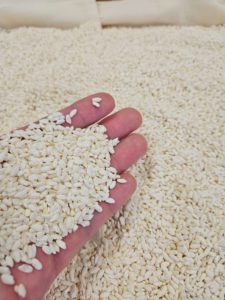
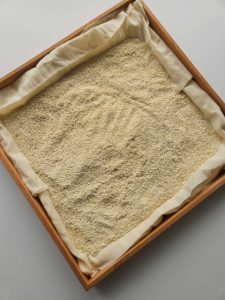
Broken Rice KojiBroken-grain rice yields higher enzyme activity, ensuring faster starch breakdown and richer umami development. |
Performance Metrics (U/g)
|
Enzyme |
Broken |
Whole |
Increase |
|
α-Amylase |
1,705 |
1,440 |
+18.4% |
|
Glucoamylase |
445 |
280 |
+58.9% |
|
Acid Protease |
8,560 |
3,005 |
+184.9% |
|
Acid Carboxypeptidase |
10,010 |
5,410 |
+85.0% |
Key Applications
|
Storage & Handling
|
Clarified Shio Koji
To make clarified Shio-Koji or Amazake, freeze the mixture and strain through cheesecloth in the refrigerator.
Recipes
Shio Koji
Ingredients: 150g water, 150g koji, 30g salt
- Equal amount of water (clear water) and koji put inside a clean jar.
- Add 10% Non-iodized salt by weight of the water and koji (eg. 100g water + 100g koji + 20g salt).
- Blend them until fully mix and creamy.
- Cover with gauze without sealing, ferment in a ventilated environment at room temperature for 7-10 days.
Tips: Adding some culinary spice could be recommended but prevent using some fresh ingredients such as garlic or onions. Dry spice such as cinnamon, vanilla bean, dry chili, star anise would be preferred. Fresh ingredients could be used with koji when marinating meats.
Miso
- Soak 150 grams of dried soybeans in the refrigerator for 18 to 24 hours. Do not peel them.
- Cook the beans until they crush easily with a pinch — 20 minutes in a pressure cooker, or 2 to 3 hours in a regular pot. Reserve the cooking water.
- Drain the beans and mash them while still warm, leaving a slight grainy texture.
- Mix 60 grams of salt thoroughly with 150 grams of dried koji to make salt koji.
- Combine the salt koji with the mashed beans. If the mixture is too dry, add the reserved bean cooking water a little at a time until it can hold a firm shape when squeezed, with a small amount of liquid seeping through your fingers.
- Form the mixture into balls and drop them firmly into a sanitized container. Press down layer by layer to remove air pockets.
- For long-term fermentation miso: Smooth the surface, sprinkle a thin layer of salt on top and clean the remain of the container with alcohol. Cover with baking paper, then plastic wrap, and place a heavy weight on top.
- Ferment at room temperature between 15°C and 25°C. Check once a week for the first month, then check once a month afterwards. [Note: A HakkoBako fermentation chamber can be used for precise temperature control during this phase.]
- A thin white film mold is normal, just scoop it off with a spoon and spray a little alcohol. Once the alcohol evaporates, re-cover with new baking paper and plastic wrap, then place the weight back on top to continue fermentation. The flavor matures well after six months. Transfer to the refrigerator for storage once you get your desired taste.
Instant Miso
- Place the container in a pot, or use any temperature-controllable equipment such as a sous vide machine, water bath, temperature-regulated stove or oven. Heat at 55–60°C for 8 hours, then it is ready to serve. [Note: For optimal results and precise PID-controlled environments between 2-60°C, a HakkoBako Professional Fermentation Chamber is highly recommended.]
Amazake
- Steam 150 grams of raw rice. Do not use leftover rice. For a sweeter taste, glutinous rice is recommended.
- Put the steamed rice, loosened rice koji and 300 ml water into a pot and mix well. Add another 50–100 ml water if the mixture is too thick.
- Transfer the mixture to a temperature-controlled container and set the temperature to 55–60°C. Ferment at a constant 55–60°C for 8 to 12 hours. [Note: The HakkoBako chamber provides precise PID temperature control for these specific requirements.]
- Stir every 1 to 2 hours during fermentation to avoid overheating and lumps.
- When done, the rice grains will turn soft, the liquid will be cloudy, and the mixture will taste distinctly sweet with no sour or bitter notes. If not sweet enough, keep warming for another 1–2 hours.
- Refrigerate immediately — it will keep for 1 week and continue to ferment slowly.
- Heat the mixture above 70°C and hold for 5 minutes to halt fermentation. It can then be refrigerated for 2–3 weeks.
Beef Koji Garum
- Cut the 750g beef into chunks, add them to a blender along with 150g koji, 112.5g salt and 375g water, then blend into a smooth puree.
- Pour the mixture into sanitized glass jars of 1.5L to 2L capacity and leave some space at the top.
- Let the mixture undergo enzymolysis at a constant 60°C for 4 to 8 weeks. Seal the jars tightly with heavy weight on top of the puree. [Note: Using a HakkoBako fermentation chamber ensures the constant temperature needed for successful enzymolysis.]
- Skim off any foam and fat from the surface during the first few weeks.
- Strain the mixture two to three times through a fine sieve lined with thick cotton cloth to get a clear sauce.
- Transfer the sauce into bottles and refrigerate it to let the flavors fully develop.
Aging Alcohol with Koji
- Use a ratio of approximately 25% koji to alcohol.
- This method is suitable for high alcohol ferments requiring longer-term aging.
- For wine: Add koji to the wine, then filter and decant within 4-6 hours. Keep the wine at 35°C during this time to speed up enzyme activity and prevent souring from oxygen exposure. Serve immediately.
- [Note: A HakkoBako fermentation chamber is recommended to maintain the precise 35°C required for these applications.]